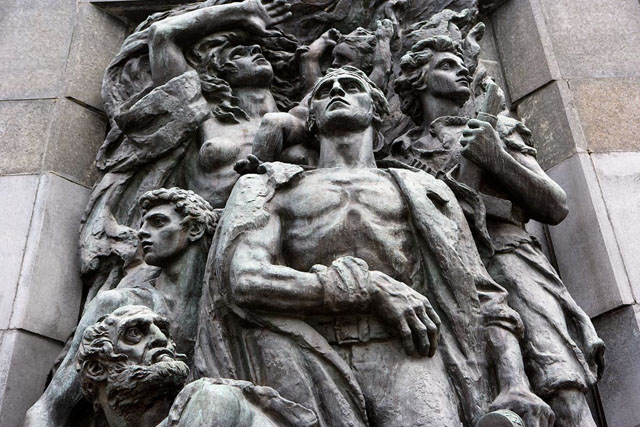
Memorial to the heroic Jewish resistance fighters of the Warsaw Ghetto Uprising
Of the many tales of sacrifice and struggle commemorated here at On This Deity, few can be more poignant or inspirational than today’s – the anniversary of the beginning of the Warsaw Ghetto Uprising.
On
this day in 1943, Nazi security forces began the work of ‘liquidating’
the Jewish ghetto in Warsaw that – since January of the same year – had
offered armed resistance to the forced deportations. The fighters of the
ghetto were from the start isolated, ill-equipped and with no real hope
of any sustainable success. But they served as a beacon of hope, and
inspired others to fight back.
Warsaw’s Jewish
community was one of the largest in Europe. And in spite of a long
history of Polish and Russian anti-Semitism, it had developed a
longstanding and thriving Jewish quarter dating back to the thirteenth
century. With the invasion of Poland by Nazi Germany in September 1939,
it was natural that Jews throughout Poland would seek refuge and support
from the community in Warsaw. Within days of the Polish army’s collapse
the Nazi authorities began to impose anti-Jewish laws and to segregate
the city.
In November the Jewish quarter was
effectively sealed off from the outside world with a 20-metre-high wall
that stretched for 11 miles. The ghetto was officially established.
With
the exception of a small number of skilled workers who left the ghetto
during the day for work, contact with or from the outside was prohibited
and enforced by death. Non-Jews were forced from the ghetto while
138,000 Jews from outside were forced in. Starvation and disease,
particularly typhoid, took a grip of the over-crowded area; by the
summer of 1941, 5,000 people were dying each month.
A
by-product of this enforced over-crowding manifested in the creation of
a community with its own self-organised hospitals, libraries,
orchestras, theatres and schools. Underground newspapers and
publications flourished as the ghetto was increasingly radicalised.
And
in this pressure-cooker environment, the full spectrum of Jewish
political organisations flourished. Two main blocs emerged. On the one
hand, there was a sometime uneasy alliance of the Left between the
Communist PRR, Left-Zionist organisations such as Hashomer Hatzair, and
the largest and longest established group – the Anti-Zionist Socialist
Bund. Together they would form the armed resistance group known as the
ZOB (Jewish Battle Organization), while another smaller group of
Rightist Zionists came together in the ZZW (Jewish Military Union).
Outside
of the resistance groups stood conservative ‘community leaders’– some
of whom formed the Jewish Council ordered by the Nazis to administer and
self-police the ghetto. Amongst their ranks there were undoubtedly
those who were opportunistic collaborators. But there were also others
who believed they could save lives by compromising with the Nazis. The
tragedy of this position is personified by Council leader Adam
Czerniaków, who committed suicide in July 1942 on realizing the full
reality of the unfolding Nazi Holocaust.
The summer
of 1942 saw the Final Solution enter a new phase. The Nazis ordered the
Jewish Council to provide 6,000 people a day for ‘deportation’. This was
initially carried out by Jewish police units – supposedly on the basis
that deportees were destined for labour camps. In fact the deportations
were to the newly built extermination camp of Treblinka, only forty
miles away. News of the camp led to a fateful decision to resist any
further deportations. And so, in autumn the first small Jewish combat
units were formed.
These groups were horrifically
ill-equipped and dependent upon stolen German small arms and a tiny
quantity of weapons smuggled in from the resistance outside the ghetto –
the Polish Home Army. But the overriding attitude of the Home Army and
the exiled Polish Government towards the Jewish groups was ambiguous at
best. Hostile to the Left and deeply tainted with traditional Polish
anti-Semitism, the Polish government in London did not provide support.
As the fighting unfolded, however, the Home Army and the smaller but
more supportive Communist resistance forces (the People’s Guard) did
provide some support, and at one point entered the ghetto to fight
alongside the Jewish resistance.
In January of 1943,
Nazi forces surrounded the ghetto and began a mass round-up for
deportation. Most of the community refused the order and Jewish fighters
took to the streets. As the fighting raged from the cellars and narrow
streets, the deportations were prevented. For twelve weeks the fighters
of the ZOB and ZZW had control of the ghetto and the German forces were
held at bay. These Jewish fighter had no long-term plan or even a hope
of survival; they knew only that they were saving their community from
certain death in the camps. The Home Army – increasingly galvanized by
the bold resistance – smuggled further weapons into the ghetto.
Even
so, most fighters were armed only with a pistol and petrol-bombs, and
could offer no real match to the tanks and artillery of the Germans. And
so, on the morning of 19th April 1943, the SS amassed their weapons at
the perimeter wall and at 6am entered the ghetto with the intention of
‘liquidation’.
Against all the odds, the ighting
continued. But by mid-May the Nazis had achieved their objective. 13,000
Jews had been killed and most of the remaining 50,000 were deported to
the death camps. Only a tiny handful of the fighters escaped, who went
on to link up with other groups – particularly the People’s Guard.
Some
of these fighters survived to participate in the uprising of the wider
city of Warsaw in August 1944. This – another story of extraordinary
courage, sacrifice and betrayal by the outside world – resulted in the
destruction of 85% of the city and the death of 220,000 Poles. Advancing
Soviet forces were only 15 kilometers away when the Home Army took
control of the city, but Stalin cynically and deliberately left the
resistance to its fate. Debate still continues as to whether the Red
Army was in a position to support the uprising, but there ca be little
doubt that an independent Poland – which may well have emerged from a
successful uprising – would have been a great inconvenience not just to
Stalin but to the future carve-up of Eastern Europe that had been agreed
amongst the Allies.
The enduring historical
significance of the Ghetto uprising remains in Israel where groups on
both the Left and Right can trace their antecedents to the Jewish
fighters. But most of all, the uprising provided inspiration both to the
wider Polish Resistance and to the Jewish People who – contrary to the
historical misrepresentation as passive victims of the Holocaust –
provided the nucleus of resistance groups throughout war-torn Europe and
led prisoner uprisings within the Nazi camps.
In the words of one of the last surviving Ghetto fighters, Marek Edelman: “No
one believed they would be saved. We knew the struggle was doomed, but
it showed the world there was resistance against the Nazis, that you
could fight the Nazis.”